Operations · Reporting
How to Reduce Report TurnaroundTime (TAT) in a Pathology Lab
Measure TAT from collection to delivery, find the hours you lose at the desk, at labelling, waiting for a signature and at dispatch, and cut them one by one.
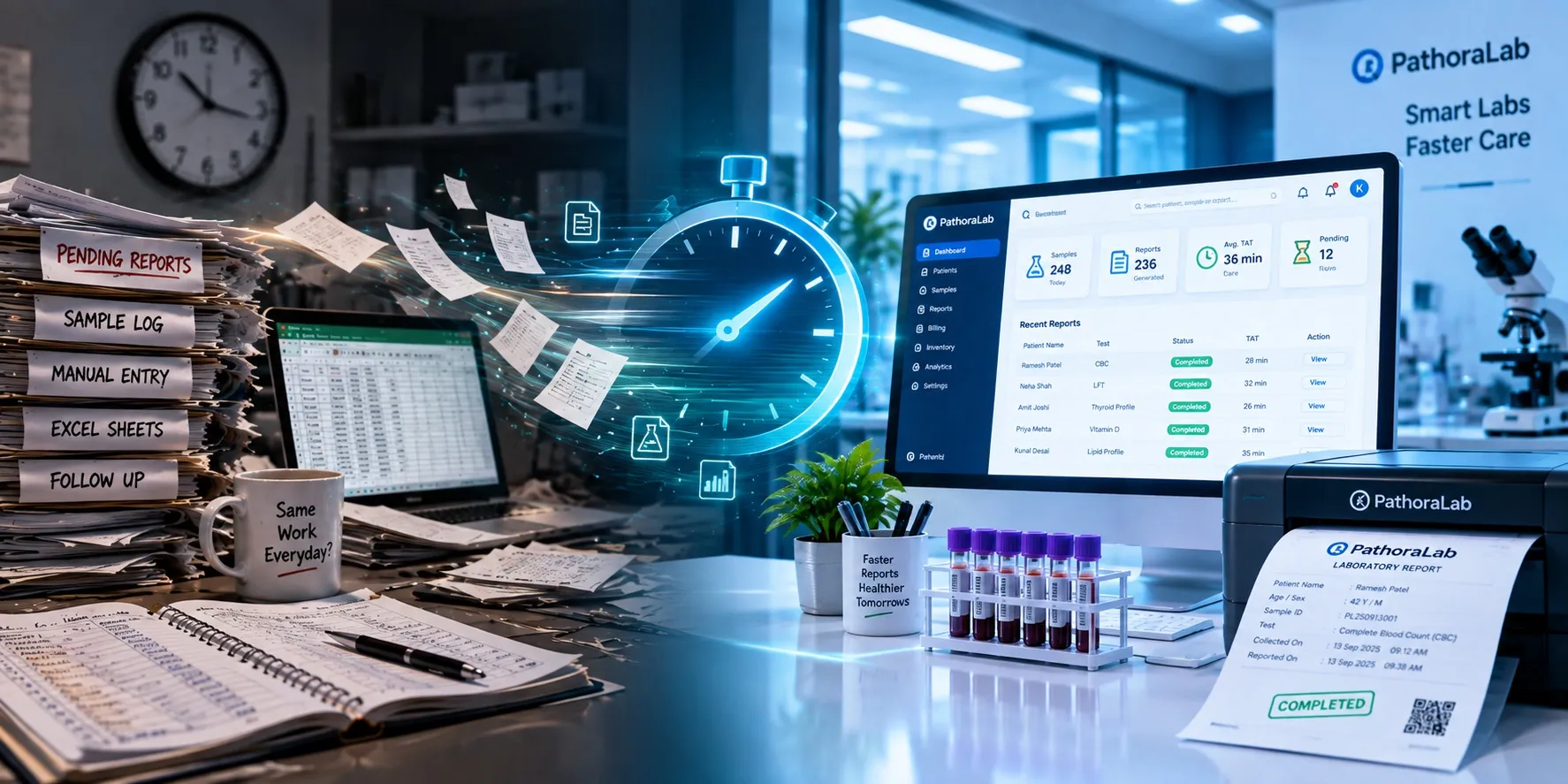
Ask ten labs their turnaround time and you get ten answers, because they are all measuring different things. One counts from when the technician starts the run. One counts from when the PDF is generated. Meanwhile the patient counts from the moment they gave their sample, and that is the number they repeat to their doctor and their neighbours.
So fix the definition first, then the process.
What TAT actually measures
The clock starts when the sample is collected and stops when the report reaches the patient or the referring doctor. Everything in between is yours, including the parts that are not laboratory work.
It helps to split it in two:
- collection to verified — the lab’s work: receipt, processing, result entry, checking, signature;
- verified to delivered — dispatch: the printout, the phone call, the WhatsApp message, the patient’s second trip to your counter.
Most labs are respectable at the first half and quietly lose hours in the second.
Measure it for a week before changing anything
For one week, note four timestamps on every sample: collected, received in the lab, verified, delivered. A notebook works if that is all you have. If your software records status changes, you already have this and only need to read it.
Then sort by total time and ignore the average. A lab with a four-hour average and a handful of three-day stragglers is judged on the stragglers, because those are the patients who call. Look at your slowest ten per cent and find what they have in common. It is usually one department, one shift, or one test.
The four places time goes missing
The registration desk. A wrong mobile number means the report goes nowhere. A repeat patient entered fresh means someone hunts for the old value later. Two minutes saved at the counter can cost you a day at the end.
Labelling and handover. Handwritten IDs on a rack, one unreadable label, and a sample gets recollected — that is a day gone for one patient, plus a phone call you did not want. Barcode labels printed at the point of collection fix more turnaround time than most software features anyone will demo to you, because they remove the step where a sample stops being findable.
Waiting for a signature. In most labs this is the biggest single block. Results are ready by two in the afternoon and reports leave at eight in the evening, because the pathologist verifies once, at the end of the day, between two centres. Three things help: a pending-verification list sorted oldest first, so nothing sits unseen; the ability to verify from wherever the doctor actually is; and a decision, in writing, about which routine reports go out as soon as they are checked instead of waiting for the evening round.
Dispatch. The report is signed, printed, put in a file, and waits for the patient to come back in the evening. Everything you saved upstream dies here.
Send the report the moment it is signed
Most patients want the report on the phone. If verification triggers the WhatsApp message straight away, your “verified to delivered” gap becomes minutes rather than hours, and your counter gets quieter. Keep the print for the ones who ask for it, and email for the doctors and corporates who file them.
Check what delivery costs before you rely on it. If each message is billed, someone in your lab will start batching them to save money, and you are back where you started. At Pathora, WhatsApp, email and print delivery are included, so nobody has a reason to hold a report back.
Where analyser interfacing fits
The usual advice is to interface your analysers first. It does remove typing and typing mistakes, and at high volume it is worth the money.
But typing a CBC is not what makes a report three days late. A verification round that happens once a day is. Get the desk, the labels, the signature routine and the dispatch right first — those cost you almost nothing — and treat interfacing as an investment for when your volume genuinely demands it. Pathora does not interface with analysers today, so this is not us talking you into something we sell.
Publish the promise, then keep it
Once your numbers are stable, write the expected time next to each test on your rate card and tell the patient at the counter. A test that takes three days is not a complaint; a test that takes three days after you said “evening” is.
Pathora gives you barcode-ready sample IDs, a worklist by department so nothing sits unnoticed, and a status trail from registered to delivered, so the answer to “where is that report” comes off a screen instead of out of a phone call. If you are still choosing a system, start with the 10-point checklist, and see the report format guide for what a clean report should carry.
Questions, answered
Common questions
What is turnaround time in a pathology lab?
The time from sample collection to the report reaching the patient or the referring doctor. Some labs measure only the time inside the lab, from sample receipt to result verification, which is useful internally but is not the number the patient experiences.
What is a reasonable turnaround time for routine tests?
Most labs deliver routine haematology and biochemistry the same day, cultures in two to three days, and histopathology in several days depending on the case. The number matters less than keeping it: a three-day test is fine if you told the patient three days at the counter.