
Reference · Reports

Pathology reportformat.

A report is a legal document that happens to contain numbers. This is what belongs on one, why each part is there, and how the shape changes between a CBC, a biopsy and a culture.

Requirements differ by state and by whether the lab is accredited. Treat this as the working anatomy, and check it against the rules you are registered under.

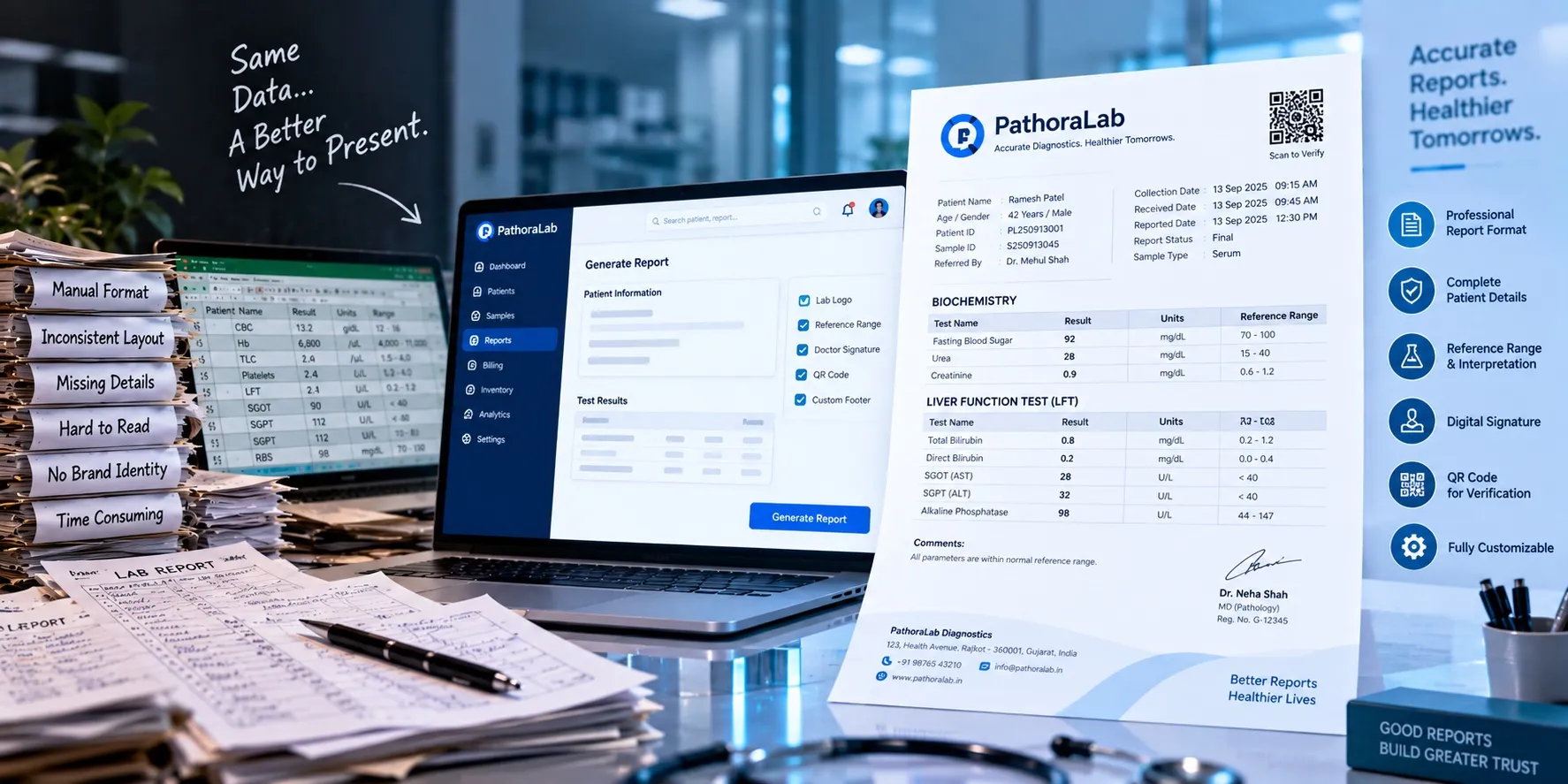
Handwritten lab sheets and a spreadsheet beside a laptop generating a PathoraLab report — patient details, biochemistry and LFT results with units and reference ranges, a pathologist's signature and a verification QR code

The shape of it

Three bands, in this order, every time.

Identification, result, authorisation. A reader scans the middle and trusts the other two — which is precisely why the other two are what an assessor reads.

Your Laboratory

Address line · Phone · Reg. No.

Band 01 — identification
Patient
Name, 46 / M
Lab No.
2608-041273
Referred by
Dr. Referring Name
Sample
Serum
Collected
12 Aug 2026, 08:42
Received
12 Aug 2026, 09:15
Reported
12 Aug 2026, 11:03

Band 02 — the result

TestResultUnitReference interval
Creatinine1.10mg/dL0.70 – 1.30
Urea52 Hmg/dL17 – 43
eGFR (CKD-EPI 2021)84mL/min/1.73 m²> 90

Method: enzymatic, IDMS-traceable · Instrument ID recorded

Band 03 — authorisation

Verified by

Dr. Pathologist Name

MD (Pathology) · Reg. No. 00000

— End of report —
Page 1 of 1

A specimen layout, not a template to copy. The point is the order and the completeness, not the typeface.

Element by element

What has to be in each band.

01

Identification — the top third

Everything that answers 'whose result is this, and which sample produced it'. This band is where the errors that matter happen, because a perfect result on the wrong name is worse than no result.

  • Lab name, address and contact — on the letterhead rather than typed into the body
  • Patient name, age and sex, exactly as registered
  • A unique lab number or accession number, and the barcode it came in on
  • Referring doctor, or 'Self' where there is none
  • Sample type, and the site where it applies (left arm, mid-stream, and so on)
  • Collection date and time, and receipt date and time — two separate stamps, not one
  • Report date and time

02

The result — the middle

The part everyone looks at, and the part most badly typeset. A result is not a number: it is a number, a unit, an interval to read it against, and a method that says how it was produced.

  • Test name, written the way a clinician would search for it
  • Result value, with the same number of decimals every time
  • Unit, in the same system throughout the report
  • Biological reference interval, matched to the patient's age and sex
  • A flag on anything outside the interval — H, L, or highlighting that survives a photocopy
  • Method or instrument, where the method changes how the number should be read
  • Previous values, where a trend is more informative than a point

03

Authorisation — the bottom

The band that makes the document a report rather than a printout. It says who is answerable for it, and it is the first thing an assessor looks for.

  • Interpretation or comment, where the result needs one
  • Verified-by: the pathologist's name, qualification and registration number
  • Signature — digital or physical, but present
  • 'End of report' so a truncated page is obvious
  • Page numbering as 'Page 1 of 3', for the same reason
  • A verification route — a QR code or a report ID the patient can check
  • A disclaimer that states the limits of the test, not the limits of your liability

One lab, four formats

The format follows the test, not the template.

Numeric panels — CBC, LFT, KFT, lipid

A table: test, result, unit, reference interval, flag. The whole panel is read by scanning down one column for anything flagged, so column alignment is not decoration — it is the interface. Group by panel, keep the decimals consistent, and never let a flag depend on colour alone, because most of these are printed in mono or photocopied.

Descriptive — histopathology and cytology

Prose, in a fixed order: specimen received, gross description, microscopic description, then impression or diagnosis. The impression carries the weight, so it belongs in its own block rather than as the last sentence of a paragraph. Include the specimen's laterality and the number of blocks or slides examined.

Culture and sensitivity

Two objects on one page: the organism, with the colony count where relevant, and the sensitivity table beneath it — antibiotic, interpretation as S / I / R, and the MIC where it is measured. Report the growth or 'no growth after 48 hours' explicitly; silence is not a result. Sensitivities belong in the lab's own reporting panel order, not the analyser's default.

Semi-quantitative and qualitative

Urine microscopy, stool examination, serology. Fix the vocabulary before the format: 'Occasional', '1+', 'Present', 'Reactive'. A lab that writes 'few' one week and '1-2/hpf' the next has made its own reports non-comparable, and no template can fix that afterwards.

Seen in the wild

Six format mistakes that cost a lab something real.

01

One timestamp instead of three

Collection, receipt and report are three different times, and the gap between them is your turnaround. A report carrying only 'Date: 12/08/2026' cannot answer a complaint about a delay.

02

One reference interval for everybody

Haemoglobin, creatinine, alkaline phosphatase and most hormones move with age and sex. A single adult-male interval printed against a nine-year-old girl's result is a wrong flag, and a wrong flag is a wrong report.

03

Flags that only exist in colour

Reports get printed in black and white, photocopied and read on a phone screen at midnight. An abnormal value needs a mark that survives all three — H/L, bold, an asterisk.

04

The verifier's name without their qualification

A name alone does not tell a clinician who signed. Name, qualification and registration number belong together, and it is commonly required at accreditation.

05

No 'end of report' and no page numbers

Multi-page reports get separated at the front desk, on the fax, in WhatsApp. Without 'Page 2 of 3' nobody knows a page is missing — including you.

06

A disclaimer written by a lawyer, not a laboratory

A useful disclaimer states the limits of the test — that results relate only to the sample received, that they need clinical correlation. A paragraph disowning responsibility for the result reads badly and protects nobody.

If you want this set up

Your format, configured with you — not a template to fill in.

Report templates, reference intervals by age and sex, flagging rules and the verification block are set up during onboarding, on your own letterhead. It is included, and it is done before you go live.

Questions, answered

Pathology report format — common questions

What must be printed on a pathology lab report?

At a minimum: the lab's identity and contact details; the patient's name, age and sex; a unique lab or accession number; the referring doctor; sample type; collection, receipt and report date and time; each test with its result, unit and biological reference interval; flags on abnormal values; and an authorisation block with the pathologist's name, qualification, registration number and signature. Specific requirements vary by state and by whether the lab is accredited, so check the rules that apply where you are registered.

Should the reference interval be printed next to every result?

Yes, and it should be the interval that applies to that patient — matched to age and sex rather than a single adult range printed against everyone. A result without its interval forces the reader to look one up, and a result with the wrong interval carries the wrong flag.

Does a pathology report need the pathologist's registration number?

It is commonly required and it is good practice regardless. The authorisation block should carry the name, the qualification and the registration number together, with a signature — digital or physical. A name on its own does not tell a clinician who verified the result.

What size should a lab report be — A4 or A5?

A4 is the practical default: it survives scanning, filing and PDF delivery, and a numeric table fits without shrinking the type. A5 is used for short single-test reports at the counter. Whichever you use, fix the margins around your pre-printed letterhead first, and check a real print before you commit the template.

How should abnormal results be marked?

With something that survives a black-and-white print and a phone screen — an H or L, bold, or an asterisk with a legend. Use colour in addition if you like, never as the only signal. Critical values need a separate route as well: a phone call, logged with who was told and when.

Can report formats be different for different tests?

They should be. A numeric panel wants a table; histopathology wants gross, microscopic and impression in a fixed order; a culture wants an organism and a sensitivity table. Forcing all three into one template is how impressions end up buried at the bottom of a paragraph.

How does Pathora handle report formats?

Templates are configured with you during onboarding, on your own letterhead — your header, your reference intervals by age and sex, your flagging, your verification block. Reports then dispatch on WhatsApp, print and email, all included, with no per-message charge.

Ready when you are

See Pathora.
See the difference.

Book a quick 30-minute walkthrough and see how Pathora turns complex laboratory workflows into one simple experience.

Or talk to our team
  • Free for 1 monthGet started without pressure
  • Data importedWe help you move everything
  • No new hardwareWorks with your setup