
Free tool · Renal

eGFRcalculator.

Estimated glomerular filtration rate from serum creatinine, using the CKD-EPI 2021 race-free equation — with MDRD shown beside it, because a lot of reports still carry it and the gap is worth seeing.

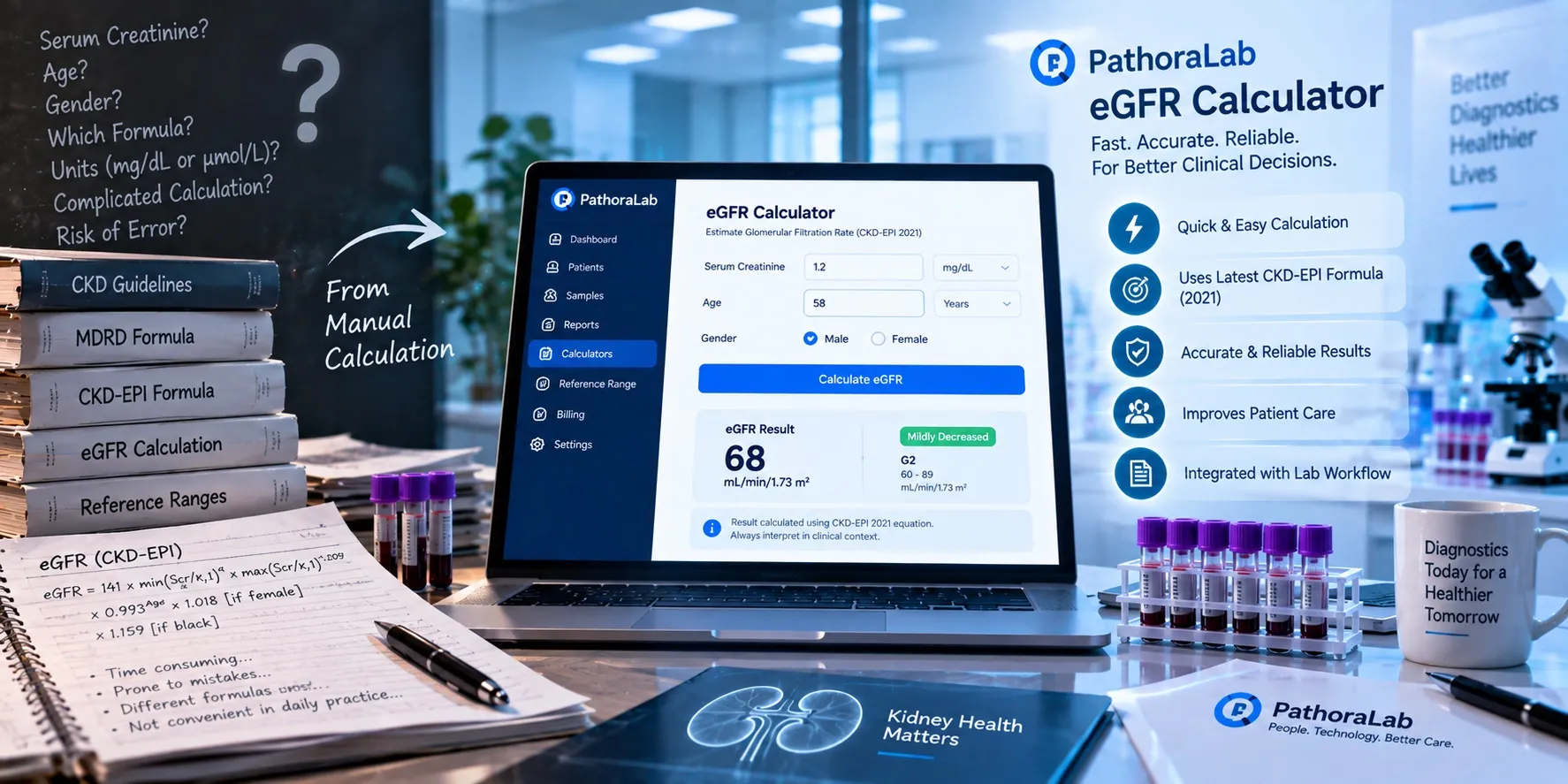
A handwritten eGFR formula and a stack of CKD guideline books beside a laptop running the PathoraLab eGFR calculator — creatinine, age and gender entered, result 68 mL/min/1.73 m² staged G2

The calculator

Creatinine, age and sex. That is all it needs.

CKD-EPI 2021 is the headline number; MDRD sits beside it so you can see how far the two drift on the same inputs, and the KDIGO category is read off the result.

Everything is calculated in your browser. Nothing is sent anywhere, and nothing is stored.

Serum creatinine

µmol/L is converted at ÷ 88.4.

Age

In years

Sex

As used by the equation

Enter a creatinine value and an age to see the estimate.

For use by clinicians and laboratory staff as a calculation aid. An estimate is not a diagnosis: CKD is staged by cause, GFR category and albuminuria together, and requires the abnormality to persist beyond three months.

Reference

GFR categories, as KDIGO defines them.

The category is one of three axes. It says how much filtration is left, not what caused the loss and not how much protein is being spilled.

CategoryeGFR (mL/min/1.73 m²)Description
G190 and aboveNormal or high
G260 – 89Mildly decreased
G3a45 – 59Mildly to moderately decreased
G3b30 – 44Moderately to severely decreased
G415 – 29Severely decreased
G5Under 15Kidney failure

The arithmetic

Exactly what this page computes.

CKD-EPI 2021 — creatinine, race-free

eGFR = 142
     × min(Scr/κ, 1)^α
     × max(Scr/κ, 1)^-1.200
     × 0.9938^age
     × 1.012  (if female)

κ = 0.7 (female), 0.9 (male)
α = -0.241 (female), -0.302 (male)
Scr in mg/dL

This is the default result above, and the one to put on a report. The 2021 refit removed the race coefficient that earlier versions carried.

MDRD — IDMS-traceable, 4-variable

eGFR = 175
     × Scr^-1.154
     × age^-0.203
     × 0.742  (if female)

Scr in mg/dL

Shown for comparison only. MDRD was fitted in a population with reduced filtration and is least reliable above 60, where it tends to read low — which is how an ordinary result becomes an unnecessary referral.

What this calculator will not do

  • Under 18 — neither equation is validated in children. Paediatric estimation uses the bedside Schwartz equation, which needs height.
  • Cystatin C — not implemented here. Where creatinine is unreliable (very low or very high muscle mass, amputation, malnutrition), a cystatin C or combined equation is the better instrument.
  • Acute change — every creatinine-based estimate assumes a steady state. In rapidly changing renal function the number lags the patient.
  • Absolute GFR — results are indexed to 1.73 m². For drug dosing at extremes of body size, de-indexed GFR may be wanted instead.

If you run the lab

A calculated parameter belongs on the report, not in a browser tab.

If your technician is retyping a creatinine into a website to get an eGFR, that is a transcription step in the middle of a result — and transcription steps are where wrong numbers come from.

  • eGFR computed from the entered creatinine, inside the report template
  • Reference ranges by age and sex, with abnormal values flagged automatically
  • Verification that only authorised users can sign, and an audit log on every change
  • Machine-wise internal quality control, so the creatinine itself is defensible

Questions, answered

About eGFR and this calculator

Which equation should a lab report?

CKD-EPI 2021. It is the current recommendation, it does not use a race coefficient, and it is more accurate than MDRD at higher filtration rates — which is exactly the range where MDRD tends to under-report and flag healthy people as reduced. This calculator uses CKD-EPI 2021 as the primary result and shows MDRD beside it for comparison.

Why does this calculator not ask for race?

Because the equation it uses does not have a race term. The 2021 CKD-EPI refit removed it deliberately: race is a social category rather than a biological measure of filtration, and the coefficient was systematically raising reported eGFR for Black patients and delaying referral. The MDRD figure shown here is calculated without the race coefficient for the same reason.

Can I use it for a child?

No. Neither CKD-EPI nor MDRD is validated under 18, and this calculator will tell you so rather than return a number. Paediatric estimation uses the bedside Schwartz equation, which needs the child's height as well as creatinine.

Is eGFR alone enough to stage chronic kidney disease?

No. KDIGO staging is by cause, GFR category and albuminuria category together, and CKD requires the abnormality to have been present for more than three months. A single eGFR is one axis of three — useful, and not a diagnosis on its own.

What is the unit, and why 1.73 m²?

mL/min/1.73 m². The estimate is indexed to a standard body surface area of 1.73 m² so that results are comparable between people of different sizes. For drug dosing at extremes of body size, absolute (de-indexed) GFR is sometimes preferred.

Does anything I type here get sent anywhere?

No. The calculation runs in your browser. There is no request to a server, nothing is stored, and no patient value is logged anywhere.

Can Pathora print eGFR on our reports automatically?

Yes. Calculated parameters can sit in a report template and compute from the entered result, so a creatinine result carries its eGFR without anyone opening a calculator. Report templates are configured with you during onboarding.

Ready when you are

See Pathora.
See the difference.

Book a quick 30-minute walkthrough and see how Pathora turns complex laboratory workflows into one simple experience.

Or talk to our team
  • Free for 1 monthGet started without pressure
  • Data importedWe help you move everything
  • No new hardwareWorks with your setup